
Experiences & Recreation · Family Activities
E.O. Wilson Biophilia Center
About
The E.O. Wilson Biophilia Center sits on State Highway 20 East in Freeport, inside the boundaries of Nokuse Preserve, a roughly 56,000-acre tract that ranks as the largest privately owned nature preserve in the southeastern United States. The preserve and its centerpiece education building were the work of M.C. Davis, a timber and oil commodities trader who, with his wife Stella, spent about $90 million buying up cutover timberland starting in 2000 and then replanted it with roughly eight million longleaf pine seedlings to restore habitat that had been logged off by the early twentieth century. The preserve’s name, Nokuse, is a Muscogee word for black bear, chosen as an umbrella symbol for the wildlife the land protects, including gopher tortoises and the fire-dependent longleaf pine ecosystem those tortoises depend on. A wildlife underpass on the property connects Nokuse to a remnant of old-growth forest on neighboring Eglin Air Force Base land.
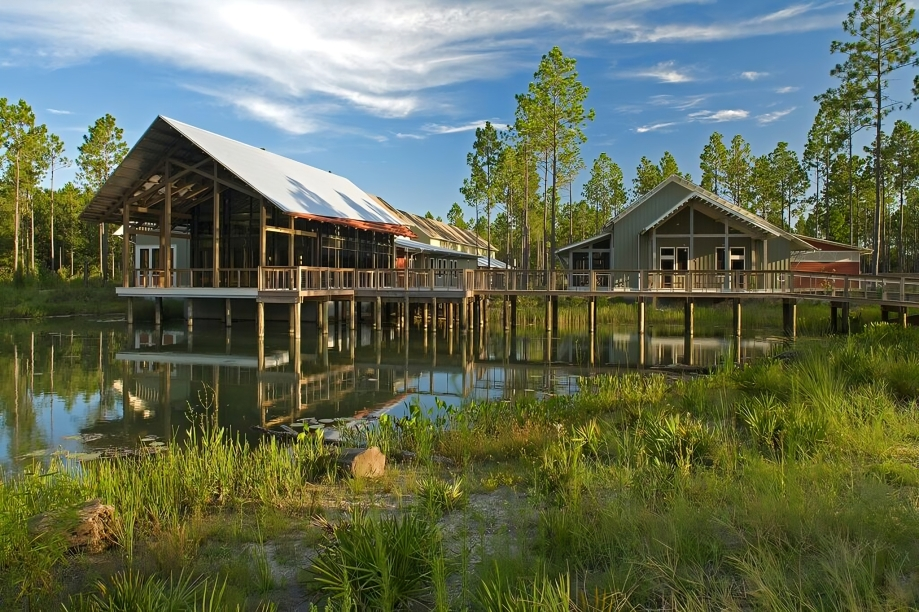
The 28,000-square-foot center is named for the biologist E.O. Wilson, a two-time Pulitzer Prize winner whose book The Diversity of Life shaped Davis’s own thinking about conservation. Wilson visited the center in person more than once after it opened in 2009, and after Davis died in 2015, Wilson called the loss “a huge loss for the conservation movement in Florida and nationally,” a measure of how closely the two men’s work had become linked. Today the center carries forward Wilson’s concept of biophilia, the idea that humans have an innate connection to the natural world, through an interactive exhibit hall and more than 40 ambassador animals living on site, along with trails winding through the surrounding preserve.
For most of its history, the center operated primarily as a field-trip destination, hosting thousands of students a year from across the Florida Panhandle alongside Summer Day Camps, a Naturalists’ Club, private and homeschool programs, and Camp Longleaf, and it opened to the general public only on a limited basis, including select summer days. As of the 2026 season, that public window runs Thursdays and Fridays from 9 a.m. to 2 p.m. That is about to change substantially: starting September 4, 2026, the center will welcome the public every Friday, year-round, for the first time in its history, moving beyond the old school-trip-and-special-event model. General admission under the new schedule is set at $15 for visitors 13 and older, $10 for ages 4 through 12, and free for children under 3, with a Bio-Membership option available for people who want free weekly Friday admission plus extras such as gift shop discounts. Visitors on a Public Friday can expect self-guided exploration, animal chats and encounters, guided hikes, and scheduled feedings.
Anyone planning a visit before that September changeover should call ahead or check the center’s site, since the current Thursday and Friday summer hours reflect a narrower, seasonal schedule rather than the expanded year-round access coming later in 2026. The center does not function as a wildlife rehabilitation facility, so anyone who finds an injured animal in the area should contact a licensed rehabber rather than bring it to the center. For visitors already exploring Freeport’s bay-side attractions, the Biophilia Center offers a different kind of stop: a chance to walk longleaf pine trails and see native Florida wildlife up close on a preserve built specifically around the idea that protecting biodiversity starts with letting people experience it firsthand, whether that means a school group during the year or a family stopping in on a summer Thursday or Friday between beach days.